The Gift of Ideas
I’ve recently started receiving a wonderful newsletter in my Inbox - Sketchplanations by Jono Hey. Jono writes beautiful posts that start with a simple graphic and then follow with a more detailed unpacking of the picture. If you are in a rush, the graphic captures the main idea as clearly as possible. If you have more time, you can dig in. A few weeks ago Jono published this beautiful graphic about ideas.
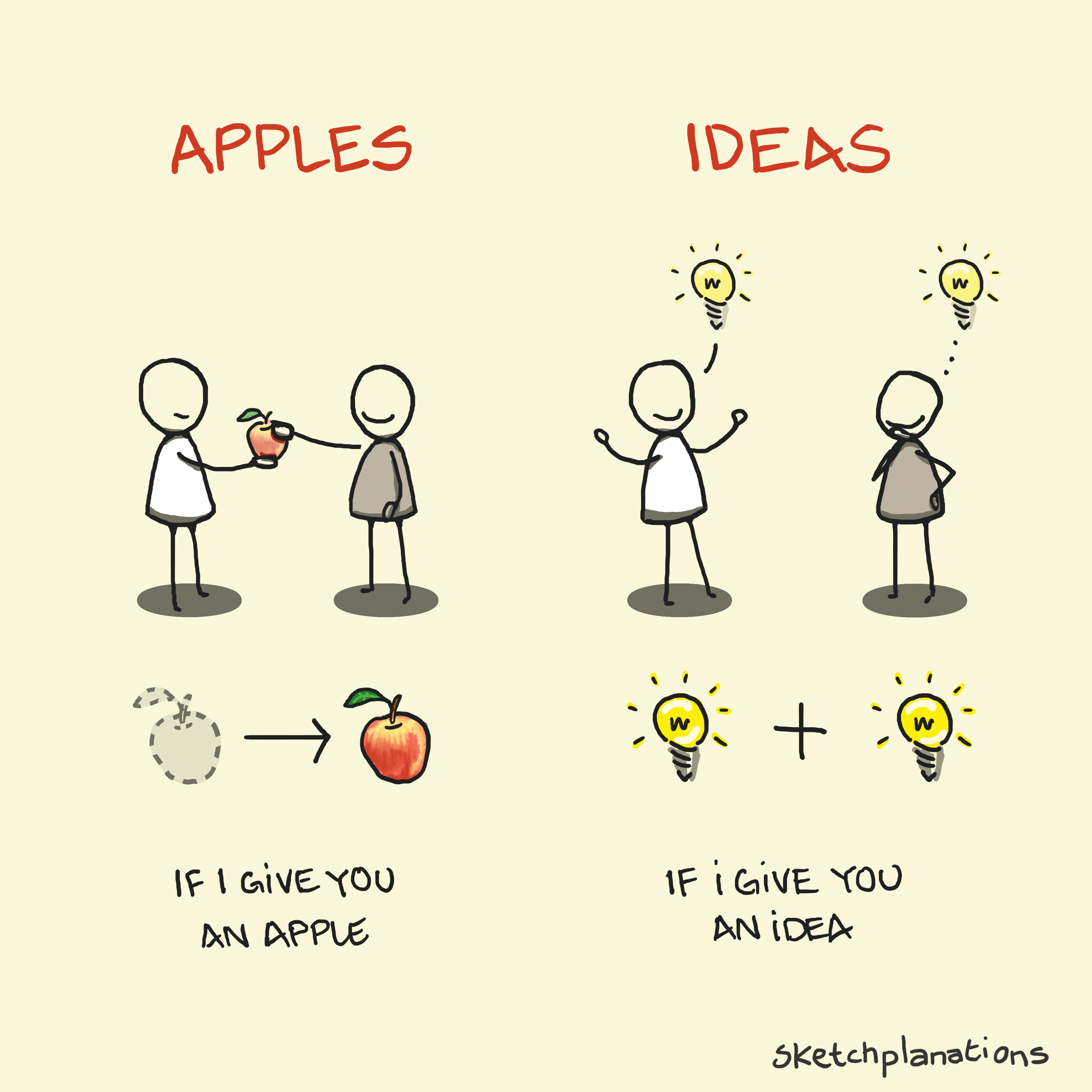
Jono Hey’s sketch of “Apples and Ideas” - https://sketchplanations.com
It’s based on a quote that is usually attributed to George Bernard Shaw, but like many a quote online, it’s not entirely clear that the words in fact started with him. It matters not - for the philosophy it expresses is so simple and profound that it falls more into the universal in any case. It goes like this. If I give you a square of chocolate (what is this nonsense about apples???), then you are now lucky enough to have this delicacy, and I no longer have it. It’s chocolate - I may therefore regret my impulse and fight to take it back or you might be kind to me and insist that we share it. But regardless of who ends up with it, there is still only one square of chocolate between us. But if I give you an idea, or you give me one, there are effectively now two ideas. We are both so much richer because the idea lives fully formed in each of us. And furthermore, the idea will grow and develop in us in different ways, because each of us brings our own life experience when we mull it over.
I am always delighted when I’m playing with a thought and the world seemingly delivers just the right connection. On the very same day that I read Hey’s newsletter, this book suggestion turned up in my inbox - “The Idea Machine” by Joel Miller. This book is a celebration of the ideas we find in books. Joel writes about the role the book plays in transmitting ideas in a structured way, but noting that part of the joy in them is that you can also access those ideas in an unstructured way - simply open at a random page and engage with whatever you find there. He uses the story of Augustine and Alypius from “The Confessions of Saint Augustine” to show that by marking a page, the idea it holds has now been captured for future reference. “Multiply the bookmarks, and they can balance one idea against others in the same or additional books. They can then use this latticework of ideas to support new insights, which can be captured in still more books and shared with subsequent readers, each of whom can have similar experiences.”
And then this morning, I indulged in my own random foray into a book, hoping it might help to trigger the writing of this blog. It’s a process I follow a lot - read something, be sparked by an idea there (no matter how loosely it connects to The Hands Manifesto), and then start connecting it to all the other ideas that are bubbling in my head. This morning I randomly opened up “Why Brains Need Friends” by Ben Rein. Ben is a neuroscientist and he writes about how important social interaction is for our overall health and wellbeing. “Sometimes a good conversation is the perfect remedy for a sour mood, especially after you’ve gone a few days without a satisfying interaction. This is more than just a relatable anecdote; it’s supported by science. Studies show that people tend to leave conversations in a better mood and with less stress.” He goes on to write that this is not just a “nice-to-have” thing in our life but absolutely critical for health and longevity. Just like the findings of neuroaesthetics which we have discussed before on this blog, social connection is every bit as important as nutrition, sleep and exercise.
So where am I going with these three different but linked ideas? They all point to the same truth: ideas gain their power when we share them, when we play with them together, when they spark new thoughts in someone else's mind. And if that's true, then we need spaces where this kind of sharing can happen - places where ideas can multiply and grow. This is what makes our social making groups so valuable. The craft group that meets in a local hall once a week, the embroidery groups that I teach around the world, the knitters who meet at their local store on a Friday evening, or the woodworking classes that my sister has been attending this year. These groups seem simple on the surface, but they hold so much power and potential to nurture individual wellbeing and to be a wellspring for creativity.
Let’s look at an example. This year, I shared the Denmark Dreaming pattern with a Canvaswork group I run once a month for the Embroiderers’ Guild of Western Australia. Denmark Dreaming was originally designed by my Mum. The group loved it and they have all been working their own versions. I wrote the pattern to deliberately not include instructions for colour. I wanted people to grow their creative confidence by choosing their own palette, especially as it’s a great way to use up bits and pieces of threads left over from other projects. I’ve loved listening to conversations around the room as people have asked each other for advice - “Do you think the red or the purple would be better here?” or “What should I use for this roof?”
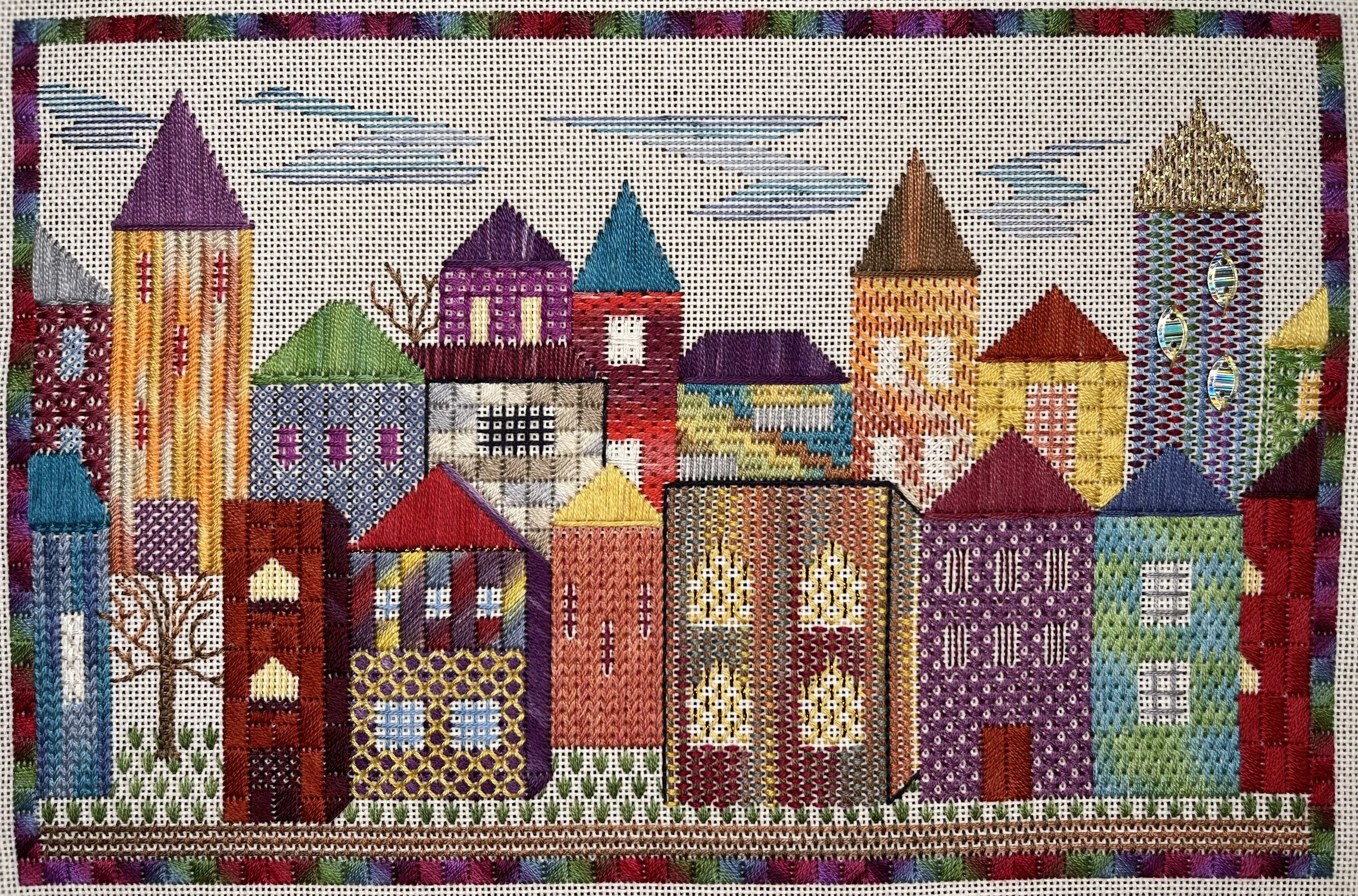
My version of Mum’s Denmark Dreaming design
But the piece that has inspired us all has been worked by Liz. As soon as she saw the design she realised that it would be the perfect starting point for a backdrop to her Christmas village. Instead of working a single rectangle, she is working a continuous scene made up of a series of panels. Every month we would gather around to see where she was up to. We watched mountains grow, and roads and rivers emerge in the foreground, and a beautiful castle rise in the centre. You could feel the excitement as ideas were shared, and I guarantee that the smiles on our faces were an indication that this was doing our bodies good.
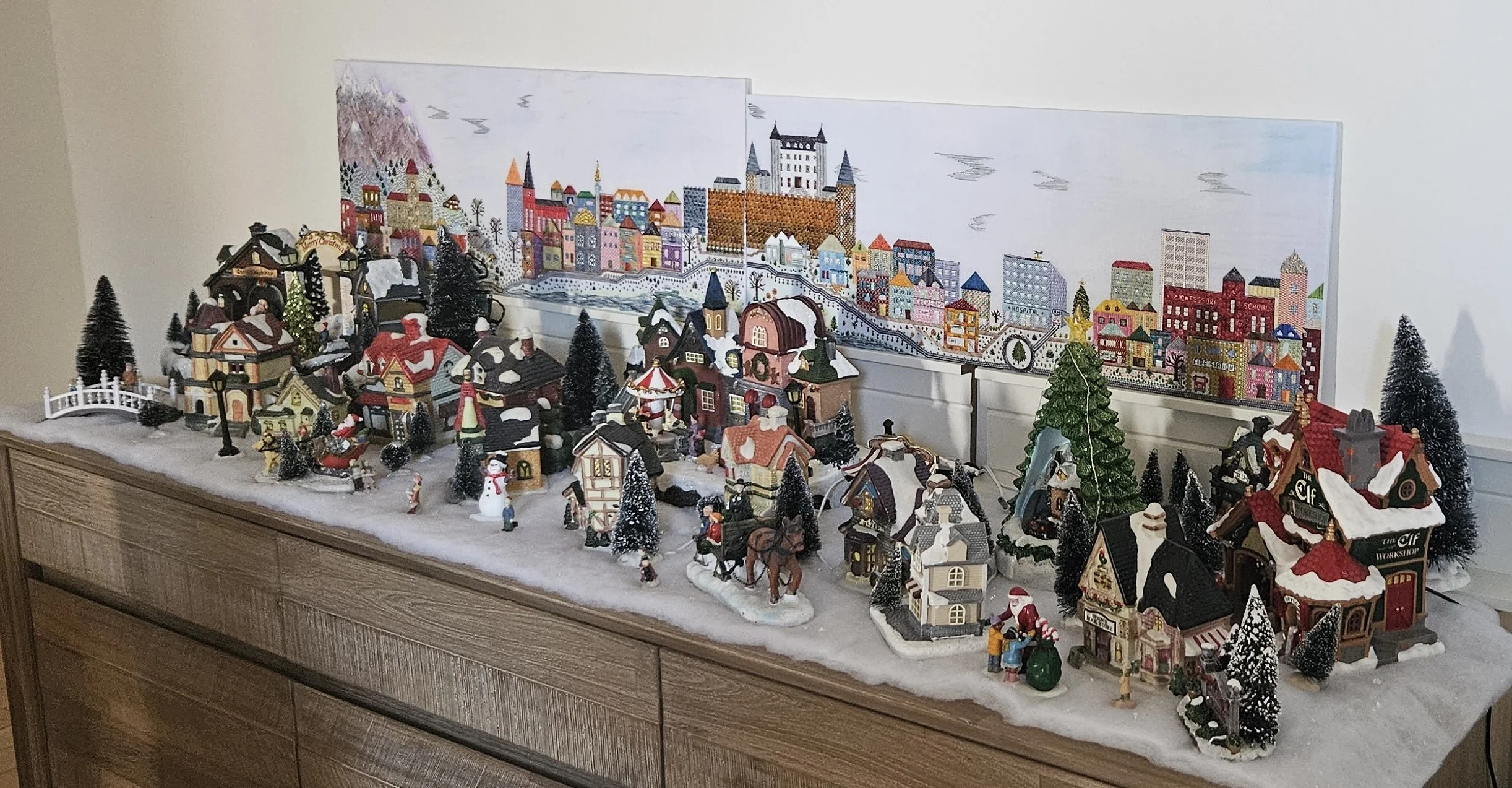
Liz’s Christmas panels that take Denmark Dreaming to a whole new level!
It’s not the same as seeing something beautiful on Instagram and then scrolling on after five seconds. It’s the genuine appreciation and excitement for seeing the work in person, for returning at least once or twice during the three hour session to admire it one more time, for loving that our friend is seeing her idea come to life, for the ideas she gives back to us by adding in tiny details like a boat with the Dutch flag on the back. These might seem like small things in a world seemingly awash with big intractable problems, but they are anything but trivial. They refill our tanks so that we can face those challenges with extra energy.
This is one of the reasons I love teaching in person so much. There is absolutely not a better feeling in the world than sharing a technique or idea and seeing the spark of excitement switch on when it lands with someone. The idea I give to them is now theirs to play with too, and out of it they will grow something new which may well go on to inspire someone else. And in so doing, we are all nurturing those crucial social connections that take such good care of our bodies and souls. Last week I caught up with a former student who had worked two of my designs and then taken elements of them to create something entirely her own. I absolutely loved it. First, because it hadn’t even occurred to me to combine those two designs. And second, because I was now bubbling with ideas. I wonder what other combinations might work well? I can’t wait to share that proposition with future students!
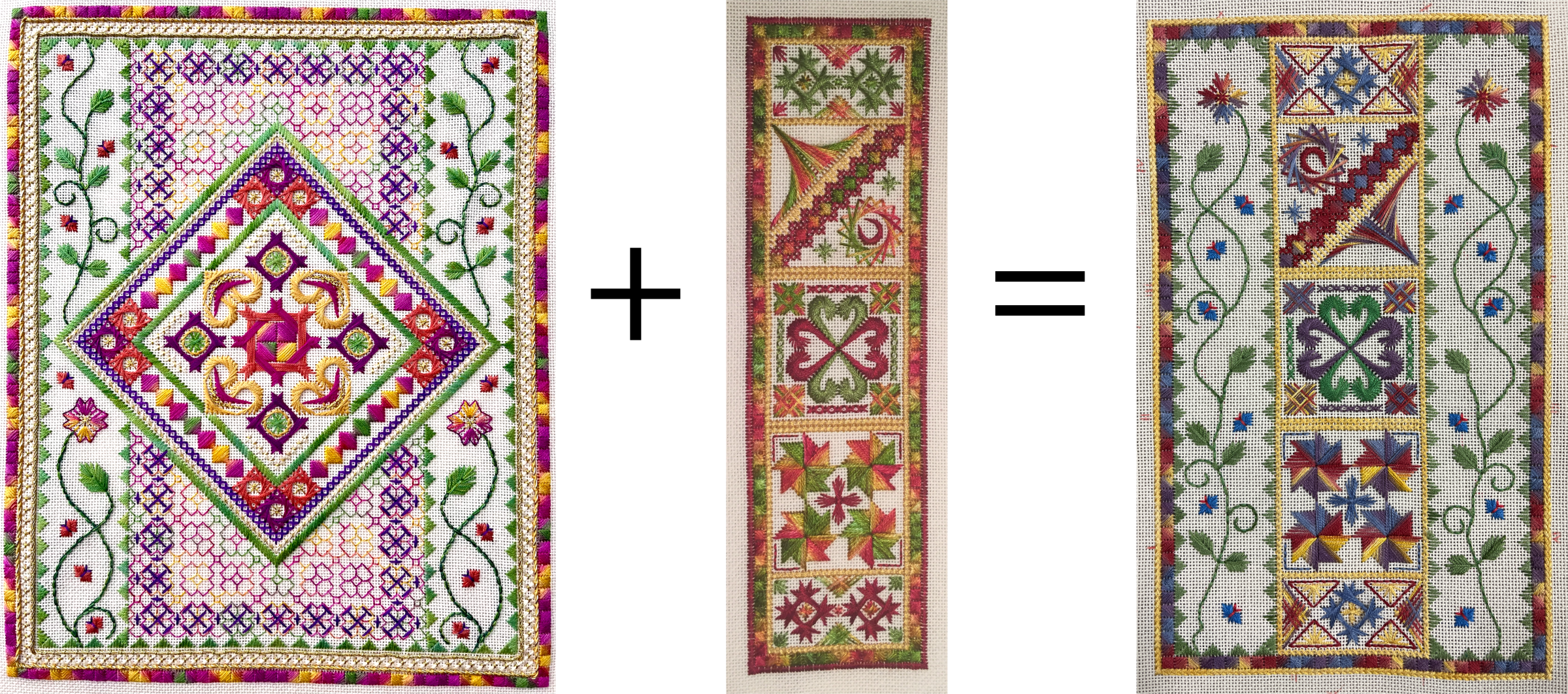
My “Grace’s Garden” plus “Autumn Fireworks” yields something completely new when Linda’s ideas take over.
Betsan Corkhill writes about these concepts in her book “Knitting for Health & Wellness”. She was one of the co-authors of a Cardiff University study in 2013 which found that “those who knitted together were more likely to feel calmer, happier, excited, useful and better about themselves”. The social benefits linked to sharing ideas around a common interest were very clear in this work. And the comments from study participants were just as clear. One wrote, “Going to parties or other social gatherings is terrifying to me. Imagine my surprise at signing up and driving to a class on how to knit a Shetland shawl without any panic or worry. I was looking forward to it. Knitting gave me the courage to reach out and socialise with other knitters.” This is such a beautiful example of the potential I see for this work. On the face of it, a class in Shetland knitting might seem like a nice thing to fill in a bit of leisure time. But here it gives a socially anxious person all the support she needs to build really beneficial social connections, as well as giving her brain all the lovely gifts of those new knitting ideas to play with.
As I write, many of us are readying to celebrate the Christmas season with family and friends. It’s a time for gift giving and sharing delicious food. But perhaps the greatest gift we can give each other is the ideas we share and explore together, and the social time we spend together when we do that. An idea shared is an idea multiplied, added to a lattice of other ideas it becomes something completely new, and sharing those conversations with friends and family is good for everyone involved.
This Week’s References
The Confessions of Saint Augustine by Saint Augustine, https://www.gutenberg.org/files/3296/3296-h/3296-h.htm
The Idea Machine: How Books Built Our World and Shape Our Future by Joel J. Miller, Prometheus, 2025.
Why Brains Need Friends: The neuroscience of social connection - and why we all need more by Ben Rein, Avery, 2025.
How to comment
I love receiving your comments and hearing your ideas! Making a comment is easy. Just type it into the box below. If you test it with “Preview” first, the name field will show “Not Logged In” (which is a system thing I can’t change). Never fear though! When you click on “Post Comment”, a dialogue box will come up asking for your Name, Email, and Website URL. The only field that must be completed is “Name”. It can be anything you choose - full name, first name, initials, nickname. So go ahead. Let me know what you think :)
