Lose yourself to find yourself
I was listening to a podcast recently where the idea of "lose yourself to find yourself" was discussed. This is a philosophy that can be interpreted in a few different ways. Some people talk about it in the sense of needing to let go of part of who they are in order to open the door to personal growth, new possibilities. Mahatma Gandhi tied finding yourself to losing yourself in service of others, so letting go of self-interest was the path to true self-discovery. For me, it's an idea that encapsulates beautifully the importance of my creative practice, and thankfully I'm not alone.
Curious to explore this idea further, I found this fabulous blog post, published only last month. JA Westenberg writes, "When you're caught up in creating something, the normal boundaries of self start to dissolve. You stop checking the time. You stop procrastinating in your inbox. You "forget" to doomscroll." In a nod to Gandhi, she goes on to say, "We're at our best when we're not thinking about ourselves at all." But it's a slightly different tone to Gandhi’s words. She isn't saying that this effort has to be explicitly in service of others, but rather in being prepared to really commit to making something.
Jacob Nordby explored similar ideas in his book, "The Creative Cure". He wrote,
“There’s a way to be both grounded and wildly imaginative, to be creative and responsible, to daydream and reach your goals.”
I love this quote. The connection between things that we might almost think of as opposites reveals so much meaning. Nordby argues (as do many others) that "our education system teaches us to see things in a fixed way, to look for the right answer and be ready to regurgitate it at the proper moment". There are of course times and places where this approach is exactly what is needed. But our over emphasis on this educational model has had some pretty significant impacts. Nordby suggests that "we tend to trade imagination for logic…we get out of practice using our imagination…looking at every situation and circumstance in our life from a single possibility rather than many".
In a podcast interview earlier this year, author Joanna Penn asked Nordby about the use of the word "cure" in the title of his book. He said, " Here's what I feel very deeply about our creative spirit … it can't be broken or damaged, but the process of becoming adults in the modern world often fills the connection between who we are out there and our true inner creative self with static." He attributes that static to the pace of change in the modern world - an unprecedented rate when compared with previous generations. It can be difficult to channel our attention and intention when the world pressures us to feel that we aren't keeping up with everything: the news, the notifications, the goals, the shoulds, etc.
This idea of speed showed up in a similar way in this Substack post by Kirk Gordon. He was musing on Paul Virilio's book "Open Sky". Virilio was a French philosopher who was deeply concerned about the impact of speed on modern society, so much so that he coined the term "dromology" to describe the study of it. He argued that moving towards instantaneity erodes the richness of the journey. If we lose the sensation of feeling the time it takes to depart and arrive, then we aren't able to build up the tapestry of memories that transform an experience from a quick high into something with deeper and longer lasting value.
This resonates so deeply with my experience of making. My stitching practice is, in many ways, a direct antidote to the speed and instantaneity that Virilio warns against. It forces me to slow down, to feel every moment of the journey from beginning to end. I can't optimise for speed because there is a literal physical limit to how fast I can work each stitch. On my newest project, there are 46 Jessicas (circular stitches) that help to define the border. Each Jessica is made up of 24 stitches - so that's 1104 stitches already. If I add in all the other stitches that build up the outer border, we are getting close to 3400. And it's only the border - there is so much more to go yet! This is not work you do for quick results. The border has taken several evenings of patient stitching, and the whole piece will evolve over a period of weeks or even months. I’ll build a relationship with my work because of the time - slow, intentional, focussed time - I choose to invest in it.
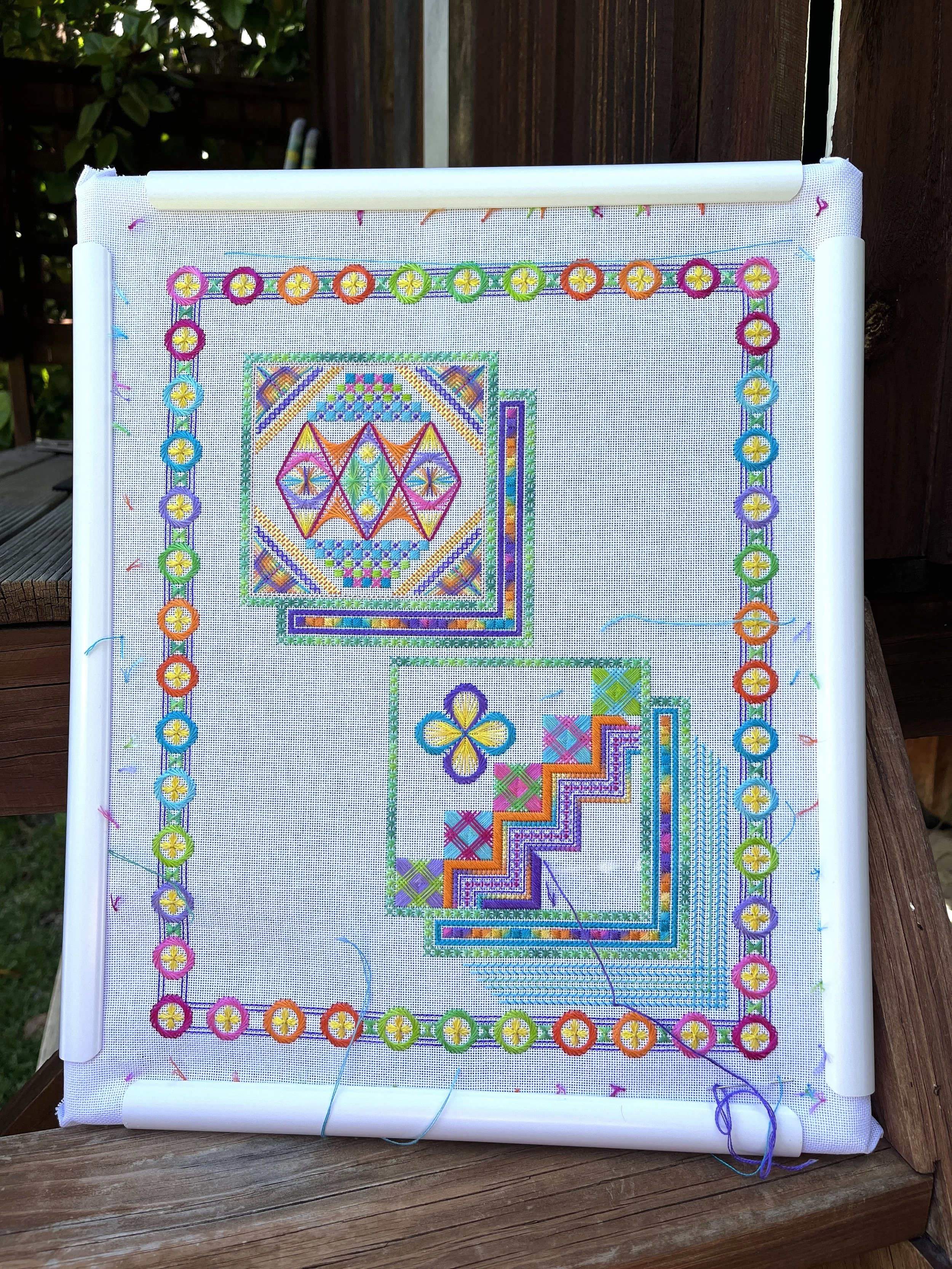
Over 3000 stitches in the border alone!
I've written about time and our relationship to it on this blog before. Perhaps it's the physicist in me, or maybe it's just natural human curiosity, but I find musing on time deeply fascinating. I was going to write that we live in a world where "we urgently need to come to terms with the problematic impacts of trying to run too fast". But even by choosing the word "urgently", I am falling into the same trap. As a society, we are obsessed with doing things faster, more efficiently. We aim to maximise our productivity with hacks and systems and to-do lists, and now AI is promising even more "time saving".
So what is really important? Is it the beauty of my embroidery or how fast I can knock out a piece? Is it the number of the likes I get on a post or that one really thoughtful comment which sparks a wonderful conversation?
From the way I've framed the questions, you can tell that I lean towards quality over metrics - always. But I recognise that the work still has to be done - there is a balance. Which is why I love Nordby's quote above so much. It holds the tension of seeming opposites. I stitch most evenings, and in that process I am "both grounded and wildly imaginative". The tactility of the process keeps me focussed through my hands - I have to be so that I can get the counting to fit and the threads to lie just how I want. But whilst I'm doing that work, my mind has the freedom to skip ahead. What colours will I use next? What new combination of stitches can I try? How would it work if I incorporated tiny LED lights into a stitched piece? (I'm yet to venture on to this one, but so cool right??) The rhythmic physicality of the stitching clears out the static that has built up in my mind over a busy day.
Similarly, when I'm writing this blog I'm dancing with "creative and responsible". Writing is something that requires commitment. I have to make time to write on a regular basis if I want to keep developing and sharing my ideas. But my thoughts also need time to grow and flourish, and sometimes that takes longer than the fortnightly schedule I try to meet. I prefer not to add to the “noise” by posting words just to meet the metrics, and putting pressure on myself to do that is a surefire way to kill creativity. So I try to stay responsible to the work without beating myself up over the shifting of (self-imposed) deadlines.
What I've learned from reflecting on my journey with Beautiful Stitches is that this creative business which I dearly love grew from the accumulation of countless tiny baby steps. Some of them took me in a productive direction, some of them did not. But the whole beautiful messy thing is fundamentally grounded in my commitment of time and focus to a very simple process - thousands and thousands and thousands of little straight stitches. And not just mine - but the work of the hundreds of people around the world who choose to work their own versions of my ideas, inspiring me to keep going. I have lost myself in the grounded nature of my stitching countless times, but I have learned so much in that process and grown in ways I could never have predicted. I have literally found parts of myself that I didn't know existed.
JA Westenberg continues her article by writing, "The best work comes from people who are pursuing a synthesis - absurd, weird, surreal, nonsensical, non-financial - that only makes sense to them. They're combining things that aren't supposed to go together, or applying tools from one domain to problems in another, or just asking questions that nobody else thought to ask. You can't plan this. It emerges when you’ve gone deep enough into something that you start seeing connections other people miss." This describes perfectly how The Hands Manifesto was "found" by "losing myself" in the work of Beautiful Stitches.
And it's why I'm so deeply committed to continuing this work. Human beings are not one-dimensional - we don't only think with our brains, we think with our bodies too. Embracing that apparent paradox is profoundly important. It's in the tension of seeming opposites that we find the richness. And one way we can help ourselves understand this is to connect with making or working with our hands. It doesn't have to be high art or meet anyone's definition of “good”. It just needs to engage us in a process that feels good, which in turn releases our minds to fly. To lose ourselves in imagination and find parts of ourselves that we didn't know existed.
This Week’s References
The Creative Cure: How Finding and Freeing Your Inner Artist Can Heal Your Life by Jacob Nordby, Red Wheel Weiser Conari, 2020.
Open Sky by Paul Virilio, Verso Books, 1997.
How to comment
I love receiving your comments and hearing your ideas! Making a comment is easy. Just type it into the box below. If you test it with “Preview” first, the name field will show “Not Logged In” (which is a system thing I can’t change). Never fear though! When you click on “Post Comment”, a dialogue box will come up asking for your Name, Email, and Website URL. The only field that must be completed is “Name”. It can be anything you choose - full name, first name, initials, nickname. So go ahead. Let me know what you think :)
